Artists

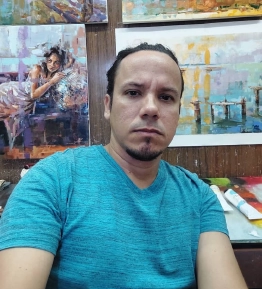
Victor must save the planimetry of the wall and the evasive maneuver in his canvases and cardboards; to intersect planes, spaces, accumulated stories, verses carved in stone as a result of that perennial dialogue between man and the forces of nature; to rise above any comfortable mimicry on his journey towards the abode of the spirit and deliver a living, malleable work, a way of interpreting any reality, not of reproducing a formal discovery or a way of life... (C. Escala Fernández).
A unique combination of Realistic Art form with the world of imaginations! Realistic painting is a key art which dwells in the sea of effectual arts… And I am a true devotee of it! (...) We know every art form has its own importance and comprehension. How if these can be unified and presented?
Abstract Surrealism. I’m interested in paradoxically assumed abstraction from the classical techniques of representation. I start from the gestures of automatism, from stains or accidents and – with them – I build on the lines and the tones or values of a reduced palette of colours. I seek to create a surreal image or atmosphere in which the amorphous figures, and their relationship with the background, give meaning to the spatiality and theatricality of the scene. The insinuated and suggested takes shape in dissimilar textures and volumes evoking man's own internal and external nature.
I believe in artistic practice as a means of knowledge, a path towards the spirit, and a constant search for the magic inherent in the universe. The work is the testimony of an enquiry into everyday life. The various presentations are evocations, searches, contacts with the desire to penetrate the flow of life.
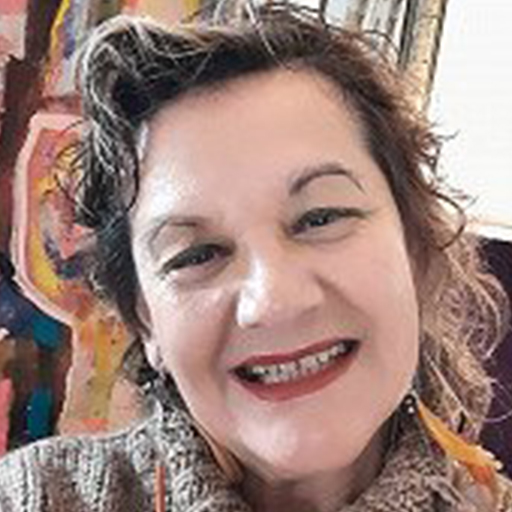
Nature has a profound influence on me and every time I meet with myself, I am with my own self. My canvas contains the language of acrylic and pastel with which I speak, conveying my thoughts and emotions. The depth of my paintings, with their sober and textured use of colour, lies in this emotionality rather than in the physicality of the visuals. Beauty may indeed be superficial, but the meaning lies elsewhere, more rooted in the heart and mind. When the viewer connects with the painting, he also joins in this conversation and shares its joy.
Inspired by his childhood memory of almost idealistic integration of utopian community in which he grew up. After the village demolished, and the community dispersed to another location, the artist began to sketch, paint, and study the remained fragment of houses. He explores the remains of ruined village searching for patterns of partially defined spaces, forms and order. The experience which he gained from the aftermath of once happy community intrigues him to ask what was the invisible force which design and maintain that urban Arcadian physical and mental environment? How is he affected by it?
In “Antelope Canyon”, there are endless possibilities for artistic compositions. That image is a study of how light sculpts spaces of texture and color into three dimensional layers captured in a two dimensional medium. With his photographs, he wants you to feel what he sees. His passion is to tell visual stories, one frame at a time. More painter than documentarian, the work hopes to showcase an impressionist approach...a type of optical painting. His grouping of images by their common connection to our earth - water, desert, trees and geology, not simply by location - is an expression of his sincere understanding and respect for our world. His artful capture of moments of light reveals an insight into our environment that only the perceptive observer can share (Mark Berndt, photographer, Santa Fe, New Mexico, United States, 2024).
The landscape – of any kind I imagine or have ever seen - provokes something inexplicable in me. I paint landscapes because I need to look at them calmly; without the rush of seeing them from a car or from a window or in any way that makes them ephemeral: the clouds, with all the shapes they build up in a matter of seconds; the mountains with all their curves, some more sensual than others; the trees (...). In short, all colour schemes, which if we stop to observe them with our eyes half-open, we can turn them into whatever comes to mind without them ceasing to be completely beautiful landscapes.
You hardly know who I am; I write, I paint since I was a child, today I do it in the silence of the mountain, surrounded by animals. I know, they drink words of love; I dispense the nectar. That a man cries or is sensitive provokes rejection, it is annoying. I am one of them; damned adrenaline. In us, gentleness is mannered and corny, almost despicable; to be strong is a bastion of the chosen, a vital skill to which few of us have access to. In love with sport and vegan, I have published several books, and I am a crazy painter, self-taught who loves the forest, and the colour aquamarine blue.
At first glance, one might think that the colour is applied in quick, frenetic strokes, but it is quite the opposite. Antoine works on canvas, rationalising each brushstroke, taking distance and continuing the process. His creations are true to his nature: energetic, but at the same time balanced. […] In the present, Basquiat and bad painting emerge in the somewhat swirling form of the brushstroke, in the way in which figuration is almost non-existent, where a taste for abstract figuration and the use of diverse frames that make his compositions very noteworthy by proposing other perspectives of the central motifs is also evident.
There are no more artists to show.
×